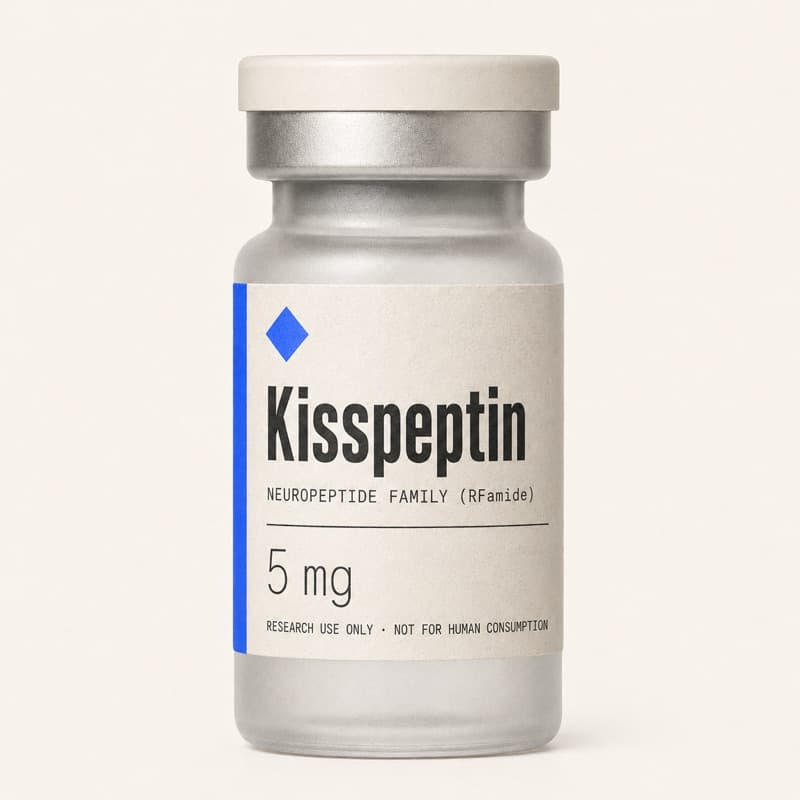
Kisspeptin
KISS1 Gene Product · Reproductive Neuropeptide
Master regulator of the reproductive system: it stimulates the GnRH neurons on which puberty, fertility, and reproductive function depend.
Overview
Master regulator of the reproductive system: it stimulates the GnRH neurons on which puberty, fertility, and reproductive function depend.
Binding occurs at GPR54/KISS1R receptors on hypothalamic GnRH neurons; pulsatile GnRH release follows, and that release drives pituitary LH/FSH secretion along with gonadal steroid production.
Research indications
What the compound has been studied for, grouped by body system. Effect size is the reported magnitude where it was measured — not a recommendation.
Oocyte maturation is triggered; the live birth rate was 45% and severe OHSS cases numbered zero, which makes it safer than hCG.
Stimulation of a dormant GnRH axis restores secretion of reproductive hormones, in functional as well as congenital cases.
In women with hypothalamic amenorrhea, pulsatility of reproductive hormones is restored.
Brain processing of sex and of attraction is modulated; self-reported sexiness increases.
Sexual brain processing is modulated, and penile tumescence rose 56% against placebo.
Influence over energy expenditure and levels of activity is suggested by preclinical evidence.
- Class
- Neuropeptide family (RFamide)
- Research status
- Emerging
- Chain length
- 10 residues
- Molecular weight
- 1213.42 Da
- Half-life
- ~4 min
- Typical dose
- 100–200 µg per injection
- Frequency
- Single dose in testing contexts, or 2–3× weekly. Daily use is reported to desensitise the receptor.
- Cycle length
- 2–4 weeks
- Storage
- Lyophilized: Room temperature. Reconstituted: 2-8°C. KP-10: use within 7 days. KP-54: use within 14 days
Molecular data
- Type
- Neuropeptide family (RFamide)
- Molecular weight
- 1213.42 Da
- Chain length
- 10 residues
- Half-life
- 4 min
Levels in single-dose multiples. A shape, not a pharmacokinetic prediction.
Dosing reference
Doses reported in the literature and by suppliers. These are a record of what has been used in research — reference, never instruction.
| Context | Route | Amount | Frequency |
|---|---|---|---|
| Gonadotropin stimulation | SubQ | 100-200mcg | Single dose or 2-3x weekly |
| Fertility support | SubQ (KP-54) | 0.4-1.0 nmol/kg (50-150mcg) | As directed by physician |
| Sexual function (clinical) | IV infusion | 1 nmol/kg/h | 75-minute IV infusion |
| Gonadotropin stimulation (research) | Intranasal | 12.8 nmol/kg | Single dose |
Interactions
GnRH release is stimulated by kisspeptin, which works upstream in the reproductive axis.
A potentially safer alternative when triggering ovulation for IVF.
LH stimulation restores natural production of testosterone.
Sex steroids modulate kisspeptin function through feedback loops.
What to expect
Safety
Mechanistic flags — properties of the pathway, not observed adverse events.
- Potential mild cardiovascular effects
- Acute side effects reported as minimal
- Cardiovascular symptoms, or pain in the chest
- Visual disturbances, or severe headaches
- Injection-site reactions that persist
- Ovarian hyperstimulation, signalled by severe pelvic pain, by bloating, by nausea
- History of cardiovascular disease warrants caution
- Receptor desensitization follows daily dosing
- Pregnancy or breastfeeding: not recommended
Quality checklist
What to confirm before trusting a batch of research material. A verification aid — not an endorsement of any supplier.
- Third-party Certificate of AnalysisIndependent lab · dated · lot-matched.
- HPLC purity ≥ 98%Reverse-phase trace included.
- Mass-spec confirms 1213.42 g/molMALDI-TOF or ESI-MS.
- Counterion stated (acetate ≫ TFA)TFA salts can confound bioassays.
- Endotoxin / sterility statementRelevant once reconstituted.
- Lyophilised · cold-chain shippedStored −20 °C, shipped on ice.
- Labelled “research use only”No therapeutic or dosing claims.
Recorded signals for this compound · 6
- ✓Light kept out by amber or opaque vials
- ✓Fluffy white powder, indicating that freeze-drying was done properly
- ✓Reconstituted solution is clear, showing neither particles nor cloudiness
- !Compaction, slight, is acceptable where a gentle swirl dissolves it completely
- ×Oxidation/degradation is indicated by yellowing or discoloration
- ×Cloudiness once reconstituted points to contamination or degradation
FAQ
How does kisspeptin compare with hCG for triggering ovulation in IVF?
It is better, and by a wide margin. Kisspeptin-54 reached 45% live birth rates with zero severe OHSS cases, where hCG carries a higher OHSS incidence. Maturation of the oocyte is triggered more physiologically, the body's own LH surge being stimulated rather than replaced by exogenous hormone.
What accounts for the response in men given kisspeptin injections?
GnRH neurons are stimulated, which sets the hypothalamic-pituitary-gonadal axis in motion. LH rises 3–5 fold from a single injection, and testosterone production follows. A 2023 trial in men with erectile dysfunction recorded penile tumescence 56% above placebo.
Is kisspeptin used daily?
No. Within days, daily dosing desensitizes the receptor and the peptide stops working. The maximum is 2–3 times weekly. Ovulation in IVF is triggered by one strategic dose; for sexual function, doses spaced 48+ hours apart hold responsiveness.
Does intranasal kisspeptin match injection for effect?
Research from 2025 reports intranasal kisspeptin-54 at 12.8 nmol/kg stimulating LH rapidly, in healthy subjects and in women with hypothalamic amenorrhea alike. The route is non-invasive and convenient, though for reproductive applications the injectable routes remain better studied.
References
- 1Efficacy of Kisspeptin-54 to Trigger Oocyte Maturation in Women at High Risk of OHSS During IVF TherapyJayasena CN, Abbara A, Comninos AN, et al. (Dhillo WS senior author) · Journal of Clinical Endocrinology & Metabolism · 2015
Live birth rates of 45% overall per transfer; 62% at optimal 9.6 nmol/kg dose. Zero cases of moderate, severe, or critical OHSS. Oocyte maturation in 95% of women.
Human RCTPubMed 26192876 ↗ - 2Effects of Kisspeptin Administration in Women With Hypoactive Sexual Desire Disorder: A Randomized Clinical TrialSheridan H, Mills EG, Sherwood RA, et al. (Jayasena CD, Dhillo WS senior authors) · JAMA Network Open · 2022
Double-masked, placebo-controlled, 2-way crossover trial in women with HSDD. Kisspeptin modulated sexual and facial attraction brain processing, with hippocampal activation correlating with distress and reduced sexual aversion.
Human RCTPubMed 36287566 ↗ - 3Effects of Kisspeptin on Sexual Brain Processing and Penile Tumescence in Men With Hypoactive Sexual Desire Disorder: A Randomized Clinical TrialMills EG, Sheridan H, Bhushan S, et al. (Dhillo WS senior author) · JAMA Network Open · 2023
32 men completed trial. Kisspeptin-54 IV (1 nmol/kg/h for 75 min) significantly modulated sexual brain processing and increased penile tumescence by up to 56% vs placebo. Potential as first pharmacological treatment for male HSDD.
Human RCTPubMed 36735255 ↗ - 4Intranasal Kisspeptin Administration Rapidly Stimulates Gonadotropin Release in HumansSheridan H, Sherwood RA, Sheridan C, et al. (Dhillo WS senior author) · eBioMedicine · 2025
Intranasal kisspeptin-54 (12.8 nmol/kg) rapidly stimulated LH release in healthy men (+4.4 IU/L), healthy women (+1.4 IU/L), and women with hypothalamic amenorrhea (+4.4 IU/L). Formulation stable for 60 days at 4°C.
Human RCTPubMed 40215751 ↗
This review examines kisspeptin and neurokinin B in reproductive health, treating kisspeptin as the physiological inductor of ovulation and covering its growing use in IVF triggering and in the management of reproductive disorders.
This review reports that exogenous kisspeptins show potential for restoring fertility, with work progressing on ovarian stimulation applications and on cryoprotection during vitrification.