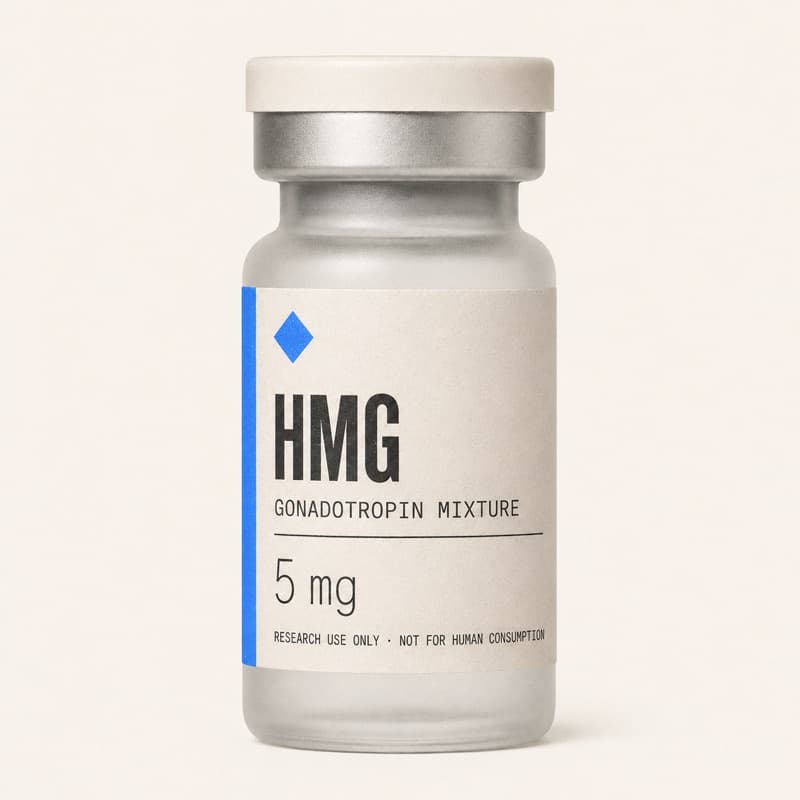
HMG
Human Menopausal Gonadotropin · FSH/LH Fertility Hormone
Hormonally active medication that carries luteinizing hormone (LH) alongside follicle-stimulating hormone (FSH), the two at a 1:1 ratio, extracted from postmenopausal women's urine. Fertility treatment is the FDA-approved use: in women it drives development of ovarian follicles, in men spermatogenesis. Some settings have largely moved to recombinant gonadotropins, but for assisted reproduction and ovulation induction HMG remains effective and cost-efficient.
Overview
Hormonally active medication that carries luteinizing hormone (LH) alongside follicle-stimulating hormone (FSH), the two at a 1:1 ratio, extracted from postmenopausal women's urine. Fertility treatment is the FDA-approved use: in women it drives development of ovarian follicles, in men spermatogenesis. Some settings have largely moved to recombinant gonadotropins, but for assisted reproduction and ovulation induction HMG remains effective and cost-efficient.
Two mechanisms carry HMG's action on gonadal tissue. The FSH component drives growth and maturation of the egg-containing ovarian follicles in women, and spermatogenesis in men. The LH component drives ovulation and corpus luteum formation in women, and in men prompts Leydig cells to produce testosterone. In highly purified form (HP-hMG), FSH receptor activity is greater and inactive proteins fewer. LH also modifies follicular development and cuts the number of intermediate-sized follicles, which may make stimulation safer and more controlled.
Research indications
What the compound has been studied for, grouped by body system. Effect size is the reported magnitude where it was measured — not a recommendation.
Follicular development is stimulated in anovulatory women.
IVF protocols use it to drive development of multiple follicles.
Effective at inducing ovulation for patients with polycystic ovary syndrome.
Sperm production is promoted by FSH; testosterone for sperm development comes from LH stimulation.
Addresses male infertility where gonadotropin production is insufficient.
Testicular testosterone production is stimulated by the LH component.
- Class
- Gonadotropin mixture
- Research status
- Extensively studied
- Half-life
- ~32 h
- Typical dose
- 75–150 IU for ovulation induction; 150–300 IU for IVF
- Frequency
- Daily during stimulation phase (7–12 days)
- Cycle length
- 7–12 days per cycle
- Storage
- Lyophilized: Room temperature. Reconstituted: 2-8°C, use immediately after reconstitution
Molecular data
- Type
- Gonadotropin mixture
- Half-life
- 1920 min
Levels in single-dose multiples. A shape, not a pharmacokinetic prediction.
Dosing reference
Doses reported in the literature and by suppliers. These are a record of what has been used in research — reference, never instruction.
| Context | Route | Amount | Frequency |
|---|---|---|---|
| Ovulation induction | IM or SubQ | 75-150 IU | Daily |
| IVF stimulation | IM or SubQ | 150-300 IU | Daily for 7-12 days |
| Male fertility | IM or SubQ | 75-150 IU | 2-3x weekly |
Interactions
Ovulation is typically triggered with hCG once HMG has driven follicular development.
A frequent component of IVF combination protocols, guarding against a premature LH surge.
Sequential protocols for ovulation induction may include it.
Mechanisms differ; the two may sit in different fertility protocols.
What to expect
Safety
Mechanistic flags — properties of the pathway, not observed adverse events.
- Injection site reactions
- Abdominal discomfort
- Ovarian enlargement
- Mood changes
- Headache
- Severe abdominal pain or bloating
- Rapid weight gain
- Difficulty breathing
- Nausea and vomiting
- Decreased urination
- Primary ovarian failure
- Uncontrolled thyroid or adrenal dysfunction
- Sex hormone-dependent tumors
- Abnormal uterine bleeding of unknown cause
- Ovarian cysts (not due to PCOS)
- Pregnancy
Quality checklist
What to confirm before trusting a batch of research material. A verification aid — not an endorsement of any supplier.
- Third-party Certificate of AnalysisIndependent lab · dated · lot-matched.
- HPLC purity ≥ 98%Reverse-phase trace included.
- Mass-spec identity confirmedMALDI-TOF or ESI-MS.
- Counterion stated (acetate ≫ TFA)TFA salts can confound bioassays.
- Endotoxin / sterility statementRelevant once reconstituted.
- Lyophilised · cold-chain shippedStored −20 °C, shipped on ice.
- Labelled “research use only”No therapeutic or dosing claims.
Recorded signals for this compound · 8
- ✓White lyophilized powder
- ✓Pharmaceutical grade product
- ✓Cold chain properly maintained
- ✓Solution clear once reconstituted
- !Quality assurance is absent from research-grade products
- ×Exposed to temperature extremes
- ×Visible particulates
- ×Powder or solution discolored
FAQ
Is HMG safe given that it comes from human urine?
Yes. Extraction is from the urine of postmenopausal women, and decades of clinical use have produced excellent safety data. Modern purification puts it on equal footing with recombinant versions for both safety and efficacy.
Are side effects lower with HMG than with recombinant gonadotropins?
The LH component may lower OHSS risk and raise fertilization rates relative to FSH-only protocols. A 1:1 FSH-to-LH ratio tracks natural physiology more closely, which may make stimulation safer and more physiologic.
What is the cost of HMG relative to recombinant FSH?
Typically 40–60% cheaper than recombinant FSH or LH products. Generic versions hold efficacy while remaining cost-effective, which matters for patients facing multiple IVF cycles.
Is HMG used for infertility in men?
Yes. It is effective in male hypogonadotropic hypogonadism: spermatogenesis is promoted by the FSH component, testosterone production stimulated by LH. Treatment usually runs months, and can bring back both sperm production and natural testosterone levels.