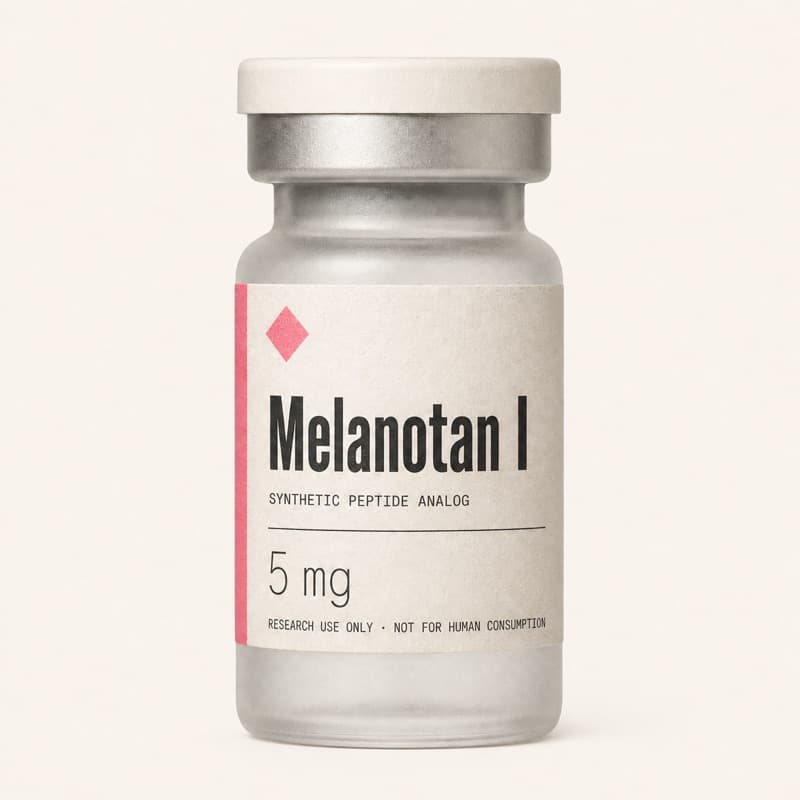
Melanotan I
Melanocortin Receptor Agonist
Synthetic α-MSH analog with selective action at MC1 receptors, stimulating melanin. As the SCENESSE implant it holds FDA approval for erythropoietic protoporphyria (EPP). The research-grade injectable allows dosing flexibility the implant version does not.
Overview
Synthetic α-MSH analog with selective action at MC1 receptors, stimulating melanin. As the SCENESSE implant it holds FDA approval for erythropoietic protoporphyria (EPP). The research-grade injectable allows dosing flexibility the implant version does not.
Delivery is by subcutaneous injection, which puts the peptide directly into systemic circulation. MC1R receptors are activated selectively, and melanin production follows. The half-life is short, approximately 30 minutes, so sustained effect requires dosing several times a day.
Research indications
What the compound has been studied for, grouped by body system. Effect size is the reported magnitude where it was measured — not a recommendation.
Melanin is stimulated, giving tans that are deeper and longer-lasting while UV requirements fall
Denser melanin gives natural UV protection and cuts sunburn
Melanin distributes uniformly, which minimizes patchy tanning
The SCENESSE implant carries FDA approval for this indication
- Class
- Synthetic peptide analog
- Research status
- FDA approved
- Molecular weight
- 1646.88 Da
- Half-life
- ~30 min
- Typical dose
- Loading: 0.25–0.5 mg daily; maintenance: 0.25–0.5 mg 2–3 times weekly
- Frequency
- Loading phase: 1–2 times daily for 1–2 weeks, then maintenance 2–3 times weekly
- Cycle length
- 2–4 week loading phase, then ongoing maintenance as needed
- Storage
- Refrigerate reconstituted solution at 2-8°C, use within 4 weeks
Molecular data
- Type
- Synthetic peptide analog
- Molecular weight
- 1646.88 Da
- Half-life
- 30 min
Levels in single-dose multiples. A shape, not a pharmacokinetic prediction.
Dosing reference
Doses reported in the literature and by suppliers. These are a record of what has been used in research — reference, never instruction.
| Context | Route | Amount | Frequency |
|---|---|---|---|
| Loading phase | Subcutaneous | 0.25-0.5mg | 1-2x daily for 1-2 weeks |
| Maintenance | Subcutaneous | 0.25-0.5mg | 2-3x weekly |
| Standard dosing | Intranasal | 0.5mg per spray | 2-3x daily |
Interactions
Mechanisms overlap; not to be combined
The required UV dose falls by approximately 50%
Provides additional photoprotection
Photosensitivity rises with retinoids; skin reactions warrant monitoring
Enhanced monitoring recommended
What to expect
Safety
- Mild nausea
- Facial flushing
- Reduced appetite
- Increased mole/freckle pigmentation
- Injection site infection signs
- Unusual skin reactions
- Allergic reaction symptoms
- Severe nausea/vomiting that lasts >24 hours
- Rapid, concerning changes to moles/freckles
Quality checklist
What to confirm before trusting a batch of research material. A verification aid — not an endorsement of any supplier.
- Third-party Certificate of AnalysisIndependent lab · dated · lot-matched.
- HPLC purity ≥ 98%Reverse-phase trace included.
- Mass-spec confirms 1646.88 g/molMALDI-TOF or ESI-MS.
- Counterion stated (acetate ≫ TFA)TFA salts can confound bioassays.
- Endotoxin / sterility statementRelevant once reconstituted.
- Lyophilised · cold-chain shippedStored −20 °C, shipped on ice.
- Labelled “research use only”No therapeutic or dosing claims.
Recorded signals for this compound · 7
- ✓Proper lyophilized powder storage
- ✓Clear, colorless reconstitution
- ✓Minimal side effects profile
- ✓HPLC testing by a third party, confirming purity >98%
- !Check expiration dates
- ×Liquid solutions sold pre-mixed (rapid degradation)
- ×Solution cloudy or discolored
FAQ
Does Melanotan I act more selectively than Melanotan II?
Yes. Selectivity for MC1R (melanin production) is higher, and activity at MC4R (sexual function, appetite) lower. Tanning therefore comes without the strong appetite suppression or sexual side effects of MT-II, which makes MT-I the better choice where tanning is the only goal.
How quickly do results from Melanotan I appear?
Skin darkening begins within 3–7 days where UV exposure is present. Peak tanning is visible by week 2–4 on consistent low-dose UV tanning. MT-I with 50% less UV exposure than normal reaches deep tans much faster than sun exposure by itself.
Is Melanotan I used without any UV exposure?
Melanin production is stimulated, so some pigment develops with no sun exposure at all. UV exposure enhances the effect significantly, however — low-dose tanning bed or sun exposure 1–2 hours after injection is what maximizes the tanning response.
Do mole changes follow Melanotan I as they do Melanotan II?
Less commonly than with MT-II, though moles and freckles can darken and potentially enlarge on MT-I. Regular skin monitoring by self-examination is important. Reduced MC3R/MC4R activation is why the risk appears lower for MT-I than for MT-II.
References
- 1Melanocortin Receptor Binding StudyPubMed · 1997
Characterized MC1R selectivity
In vitroPubMed 9409624 ↗ - 2Pharmacokinetics Injectable MT-IPubMed · 1997
Established half-life and bioavailability parameters
Review · inferredPubMed 9288095 ↗ - 3MT-I Photoprotection StudyPubMed · 2004
Demonstrated significant photoprotection effects
Human RCTPubMed 15262693 ↗