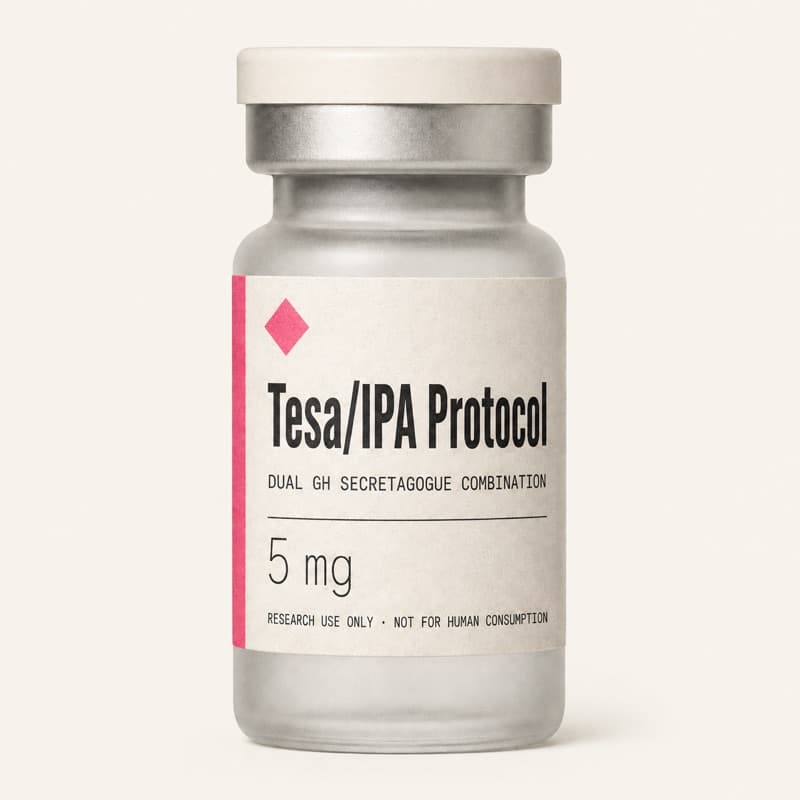
Tesa/IPA Protocol
Tesamorelin + Ipamorelin GH Secretagogue Blend
The Tesa/IPA blend pairs two growth hormone secretagogues that complement one another: Tesamorelin, a GHRH analog prompting GH release from the pituitary, and Ipamorelin, a selective ghrelin mimetic/GHRP that amplifies GH pulses. Both the GHRH and the GHRP pathway are covered, for synergistic GH release. Formulations in common use are 5mg/5mg (1:1 ratio) and 10mg/3mg (more Tesamorelin). Tesamorelin holds FDA approval for HIV-associated lipodystrophy; Ipamorelin stays investigational.
Overview
The Tesa/IPA blend pairs two growth hormone secretagogues that complement one another: Tesamorelin, a GHRH analog prompting GH release from the pituitary, and Ipamorelin, a selective ghrelin mimetic/GHRP that amplifies GH pulses. Both the GHRH and the GHRP pathway are covered, for synergistic GH release. Formulations in common use are 5mg/5mg (1:1 ratio) and 10mg/3mg (more Tesamorelin). Tesamorelin holds FDA approval for HIV-associated lipodystrophy; Ipamorelin stays investigational.
Two separate GH-releasing pathways are put to work by the blend. Tesamorelin, a synthetic GHRH analog, stimulates growth hormone-releasing hormone receptors on pituitary somatotrophs directly, and GH synthesis and secretion follow in pulsatile, physiological fashion. Ipamorelin is selective for the ghrelin receptor (GHS-R1a); as an agonist there it amplifies GH pulses, leaving cortisol and prolactin largely unaffected. The pair release GH synergistically, beyond what either compound manages alone, and natural feedback mechanisms stay intact.
Research indications
What the compound has been studied for, grouped by body system. Effect size is the reported magnitude where it was measured — not a recommendation.
Visceral adipose tissue is specifically reduced by Tesamorelin — the FDA-approved indication.
With GH enhanced, protein synthesis is promoted and lean tissue preserved.
Clinical trials have demonstrated fat reduction with Tesamorelin; the synergy with Ipamorelin may enhance the effect.
Deep sleep quality often improves under GH secretagogues.
Enhanced GH lends support to tissue repair, and to recovery after exercise.
Anti-aging benefits may follow from restoring GH levels closer to youthful ones.
Studies have shown Tesamorelin improving lipid parameters.
IGF-1 production rises as GH rises.
- Class
- Dual GH secretagogue combination
- Research status
- Limited research
- Typical dose
- 200–500 µg total blend per injection
- Frequency
- Once daily (evening) or twice daily
- Cycle length
- 8–16 weeks continuous
- Storage
- Reconstituted: 2-8°C, use within 4-6 weeks
Molecular data
- Type
- Dual GH secretagogue combination
Dosing reference
Doses reported in the literature and by suppliers. These are a record of what has been used in research — reference, never instruction.
| Context | Route | Amount | Frequency |
|---|---|---|---|
| Standard protocol (5/5 blend) | SubQ | 200-400mcg total | Once daily (evening) |
| Enhanced protocol (10/3 blend) | SubQ | 300-500mcg total | Once daily (evening) |
| Twice daily (advanced) | SubQ | 200-300mcg per dose | Morning and evening |
Interactions
Tesamorelin is already in the blend; more is not to be added.
Ipamorelin is already in the blend; more is not to be added.
CJC-1295 is a GHRH analog, as is Tesamorelin; the combination may stimulate excessively.
Ipamorelin already covers the GHRP pathway, so further GHRPs may be excessive.
GH release is affected by both; combined, the effect may be excessive and reach glucose.
Separate mechanisms that can combine healing with GH support.
Pathways differ; some pair them for body composition goals.
Glucose metabolism is affected by GH; careful monitoring applies for diabetics.
What to expect
Safety
Mechanistic flags — properties of the pathway, not observed adverse events.
- Water retention (usually transient)
- Joint stiffness
- Increased hunger (Ipamorelin effect)
- Numbness or tingling in the extremities
- Reactions where injected — redness, itching
- Significant swelling or edema
- Signs of glucose dysregulation
- Severe joint pain
- Allergic reactions
- Severe reactions at the injection site
- Diabetic retinopathy
- Pregnancy or breastfeeding
- Pituitary disorders
- Hypersensitivity to components
- Active malignancy, where GH may promote tumor growth
Quality checklist
What to confirm before trusting a batch of research material. A verification aid — not an endorsement of any supplier.
- Third-party Certificate of AnalysisIndependent lab · dated · lot-matched.
- HPLC purity ≥ 98%Reverse-phase trace included.
- Mass-spec identity confirmedMALDI-TOF or ESI-MS.
- Counterion stated (acetate ≫ TFA)TFA salts can confound bioassays.
- Endotoxin / sterility statementRelevant once reconstituted.
- Lyophilised · cold-chain shippedStored −20 °C, shipped on ice.
- Labelled “research use only”No therapeutic or dosing claims.
Recorded signals for this compound · 9
- ✓Reputable research supplier
- ✓Ratios verified on the certificate of analysis
- ✓Shipped with a proper cold chain
- ✓Testing by a third party that confirms both components
- !Ipamorelin remains investigational
- !Egrifta is the FDA-approved form of Tesamorelin; research blends carry no such approval
- ×No Certificate of Analysis
- ×Solution discolored or particulate
- ×The Tesamorelin:Ipamorelin ratio cannot be verified
FAQ
What does combining tesamorelin and ipamorelin achieve over separate use?
The two act on complementary GH-release pathways (GHRH against GHRP receptors), and the GH release that results is synergistic, greater than either alone. Natural pulsatile GH secretion is mimicked more effectively by the pair, and safety holds: cortisol and prolactin are elevated less than with GHRPs used solo.
How do the 5/5 and 10/3 Tesa/IPA ratios differ in application?
Equal parts at 5/5 give balanced GH stimulation, suited to general recovery. The 10/3 variant, weighted toward tesamorelin, emphasizes visceral fat loss and metabolic effects. Athletic recovery points to 5/5; fat-loss protocols with body composition optimization goals point to 10/3.
Is the Tesa/IPA blend taken on an empty stomach?
Yes — both work best with nothing in the stomach, 2–3 hours before eating. Injecting in the evening before bed on an empty stomach is what optimizes the protocol: it lines up with the GH pulses that occur naturally at night, and food-induced metabolic interference is avoided.
Does Tesa/IPA go alongside CJC-1295 or further GH secretagogues?
No. The blend already carries both the GHRH and the GHRP pathway, so piling on more GHRPs or GHRH analogs risks stimulating the pituitary excessively. Its design is a complete dual-pathway system — one that shouldn't call for further GH secretagogues.
References
- 1Ipamorelin, the first selective growth hormone secretagogueRaun K, Hansen BS, Johansen NL, et al. · European Journal of Endocrinology · 1998
Ipamorelin is the first GHRP-receptor agonist with selectivity for GH release similar to GHRH; does not release ACTH or cortisol even at doses over 200-fold the ED50 for GH.
Animal in vivoPubMed 9849822 ↗ - 2Metabolic effects of a growth hormone-releasing factor in patients with HIVFalutz J, Allas S, Blot K, et al. · New England Journal of Medicine · 2007
Landmark RCT in 412 HIV patients: tesamorelin 2 mg daily for 26 weeks reduced visceral fat by 10.9% vs 0.6% placebo, improved lipid profiles with no change in subcutaneous fat.
Human RCTPubMed 18057338 ↗
In the first study devoted to people with HIV taking INSTI-based regimens, tesamorelin cut visceral and hepatic fat and the ratio of trunk to appendicular fat, and glycaemic control did not deteriorate.
In a phase 2 randomised trial of 73 people with HIV and abdominal obesity, tesamorelin lowered waist circumference compared with standard of care, while neurocognitive gains fell short of statistical significance.
Pooling five randomised trials, this meta-analysis found tesamorelin cuts visceral adipose tissue among adults with HIV-associated lipodystrophy.