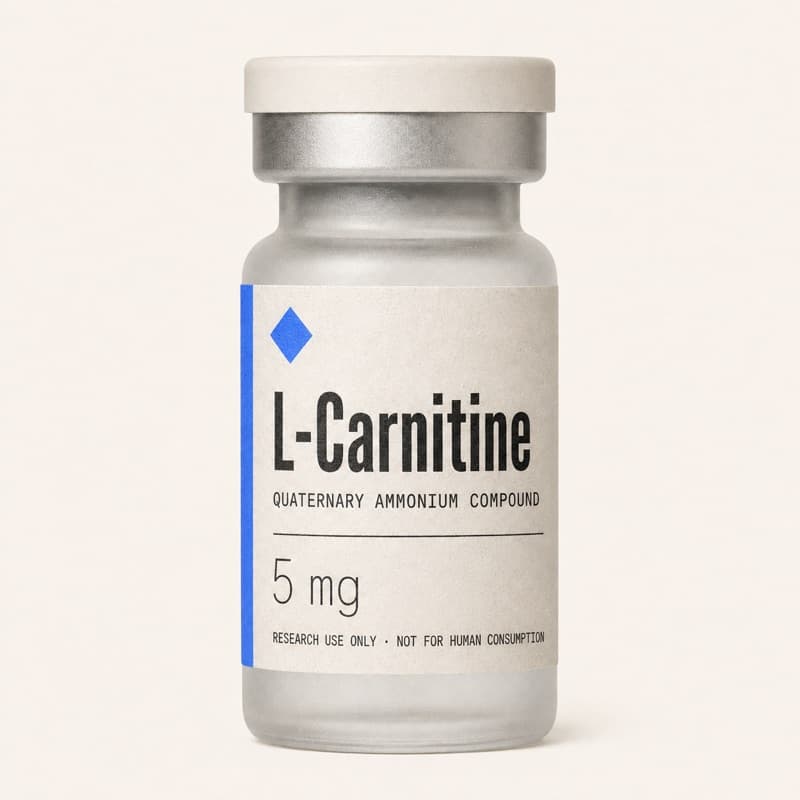
L-Carnitine
Amino Acid Derivative · Fatty Acid Transporter
Amino acid derivative the body produces naturally; its job is transport of long-chain fatty acids into the mitochondria, where energy is produced. Oral supplements face absorption limits in the digestive tract that injectable forms sidestep.
Overview
Amino acid derivative the body produces naturally; its job is transport of long-chain fatty acids into the mitochondria, where energy is produced. Oral supplements face absorption limits in the digestive tract that injectable forms sidestep.
The role is that of a carrier molecule: long-chain fatty acids are shuttled across the inner mitochondrial membrane by way of the carnitine palmitoyltransferase (CPT) system. In fatty acid oxidation for energy production, that step is rate-limiting.
Research indications
What the compound has been studied for, grouped by body system. Effect size is the reported magnitude where it was measured — not a recommendation.
Transport of fatty acids into the mitochondria, where beta-oxidation occurs, is the primary function.
ATP generation out of fat metabolism is supported, during exercise in particular.
Fat utilization may be enhanced where exercise and a caloric deficit accompany it.
Markers of muscle damage may fall and post-exercise recovery may improve.
Fat utilization rises through prolonged exercise, with glycogen potentially spared.
Carnitine deficiency, primary and secondary, has this as an FDA-approved treatment.
Given to hemodialysis patients in whom carnitine depletion develops.
- Class
- Quaternary ammonium compound
- Research status
- Extensively studied
- Molecular weight
- 161.2 Da
- Half-life
- ~2.5 h
- Typical dose
- 50–200 mg daily
- Frequency
- Once daily or pre-workout
- Cycle length
- 8–16 weeks (can be used continuously)
- Storage
- Lyophilized: -20°C; Reconstituted: 2-8°C for 2-4 weeks
Molecular data
- Type
- Quaternary ammonium compound
- Molecular weight
- 161.2 Da
- Half-life
- 150 min
Levels in single-dose multiples. A shape, not a pharmacokinetic prediction.
Dosing reference
Doses reported in the literature and by suppliers. These are a record of what has been used in research — reference, never instruction.
| Context | Route | Amount | Frequency |
|---|---|---|---|
| Standard Protocol | SubQ | 50-100mg | Daily |
| Advanced Protocol | SubQ or IM | 100-200mg | Daily |
| Pre-Workout | SubQ | 100-200mg | 30-60 min before exercise |
Interactions
Thyroid hormone action may be affected by L-carnitine. Levels warrant monitoring where thyroid medication is in use.
Warfarin and similar medications may have their effects enhanced.
What to expect
Safety
- Injection site reactions
- Mild nausea
- Fishy body odor at high doses
- Severe gastrointestinal distress
- Unusual muscle weakness
- Rare allergic reactions
- Allergy to carnitine products
- Seizure disorders — the seizure threshold may drop
- Hypothyroidism — thyroid function may be affected
Quality checklist
What to confirm before trusting a batch of research material. A verification aid — not an endorsement of any supplier.
- Third-party Certificate of AnalysisIndependent lab · dated · lot-matched.
- HPLC purity ≥ 98%Reverse-phase trace included.
- Mass-spec confirms 161.2 g/molMALDI-TOF or ESI-MS.
- Counterion stated (acetate ≫ TFA)TFA salts can confound bioassays.
- Endotoxin / sterility statementRelevant once reconstituted.
- Lyophilised · cold-chain shippedStored −20 °C, shipped on ice.
- Labelled “research use only”No therapeutic or dosing claims.
Recorded signals for this compound · 7
- ✓White crystalline powder
- ✓After reconstitution, solution clear and colorless
- ✓Purity testing included in the certificate of analysis
- !Complete dissolution, no residue left
- ×Strong unusual odor
- ×Powder discolored
- ×Solution cloudy or with particles
FAQ
What does injection offer over oral L-carnitine supplements?
Bioavailability of oral L-carnitine runs 15–20%, held down by poor intestinal absorption. The injectable route reaches close to 100%, putting much higher effective doses straight into circulation. Where cost and needle anxiety are not factors, injection is significantly more efficient.
Does fat loss actually follow from L-carnitine?
Transport of fatty acids into the mitochondria for energy production is enhanced. The effect is best where exercise and a caloric deficit are in place. Benefits are modest — 5–10% improvements in fat loss — and show up most visibly in well-trained athletes, or in cases of pre-existing carnitine deficiency.
Is L-carnitine taken before cardio?
Yes. An injection of 100–200 mg, 30–60 minutes ahead of endurance exercise, optimizes fatty acid utilization and may improve performance slightly. Timing is set to maximize fat-burning potential, though the benefit is most apparent through prolonged low-to-moderate intensity work.