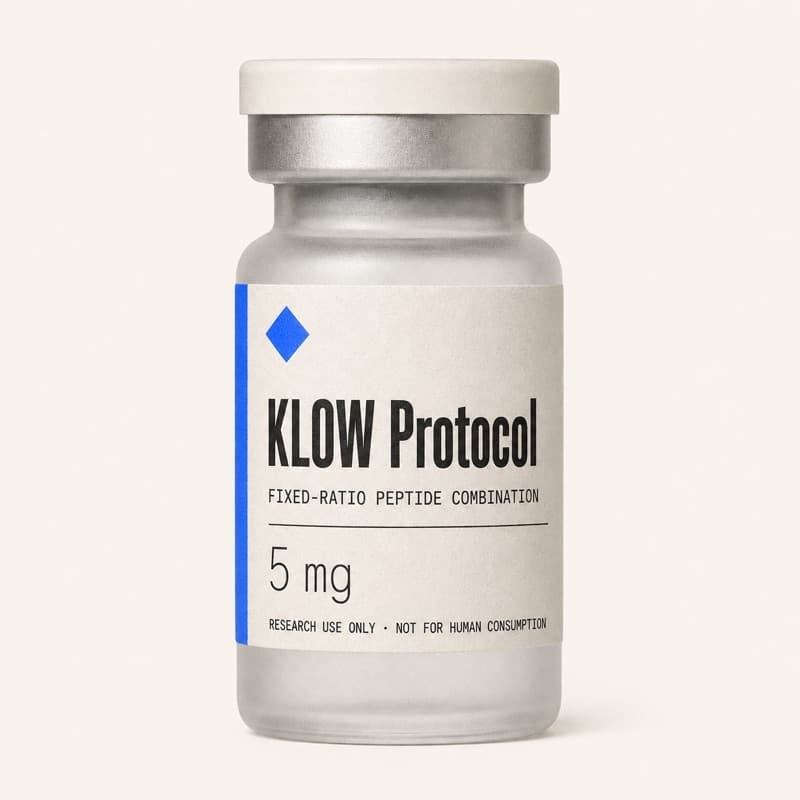
KLOW Protocol
Four-Peptide Regenerative Blend
KLOW extends the GLOW protocol with KPV, adding anti-inflammatory action. No clinical trials cover this specific four-peptide formulation, whatever research exists on the individual components. A standard vial holds an 80mg blend: 50mg GHK-Cu, 10mg TB-500, 10mg BPC-157, 10mg KPV.
Overview
KLOW extends the GLOW protocol with KPV, adding anti-inflammatory action. No clinical trials cover this specific four-peptide formulation, whatever research exists on the individual components. A standard vial holds an 80mg blend: 50mg GHK-Cu, 10mg TB-500, 10mg BPC-157, 10mg KPV.
A distinct biological pathway comes from each peptide: gene expression for tissue repair is modulated by GHK-Cu; cellular migration and wound healing are enhanced by TB-500; growth factors for tissue regeneration are upregulated by BPC-157; and the NF-κB inflammatory pathway is inhibited by KPV.
Research indications
What the compound has been studied for, grouped by body system. Effect size is the reported magnitude where it was measured — not a recommendation.
Healing is multi-modal, tissue addressed by way of complementary pathways
Tolerability is better with KPV than in the GLOW formulation
Single injection convenience factor
Stimulation of collagen, regeneration of tissue
- Class
- Fixed-ratio peptide combination
- Research status
- Limited research
- Typical dose
- 200–500 µg total blend daily
- Frequency
- Once daily
- Cycle length
- 4–6 weeks
- Storage
- Lyophilized: Room temperature. Reconstituted: 2-8°C, use within 4-6 weeks
Molecular data
- Type
- Fixed-ratio peptide combination
Dosing reference
Doses reported in the literature and by suppliers. These are a record of what has been used in research — reference, never instruction.
| Context | Route | Amount | Frequency |
|---|---|---|---|
| Conservative approach | Subcutaneous | 200mcg total daily | Once daily evening |
| Standard research protocol | Subcutaneous | 200-500mcg total | Once daily |
| Cycling protocol | Subcutaneous | Per standard dosing | 4-6 weeks on, 2-4 weeks off |
Interactions
Every GLOW component is in KLOW, with KPV added; combining the two double-doses
The combination is unstudied; compatibility is theoretical, resting on the mechanisms being different
KLOW with NAD+ has no data behind it; cellular processes are affected differently by each
Clotting and wound healing may be affected by the components, so medical supervision is required
GH pathways are affected by more than one component; excessive stimulation is a risk
Interference with immunosuppressive therapy is possible from the components
What to expect
Safety
Mechanistic flags — properties of the pathway, not observed adverse events.
- Individual responses vary widely
- Reactions at the injection site, common even where KPV is included
- Unusual fatigue or weakness
- Severe reactions at the injection site, or infection
- Allergic reactions, with rash or difficulty breathing
- Copper toxicity signs: nausea, jaundice
- Underlying conditions that worsen
- Long-term effects completely unknown
- The four-peptide combination has no safety studies
- No component carries FDA approval for therapeutic use
Quality checklist
What to confirm before trusting a batch of research material. A verification aid — not an endorsement of any supplier.
- Third-party Certificate of AnalysisIndependent lab · dated · lot-matched.
- HPLC purity ≥ 98%Reverse-phase trace included.
- Mass-spec identity confirmedMALDI-TOF or ESI-MS.
- Counterion stated (acetate ≫ TFA)TFA salts can confound bioassays.
- Endotoxin / sterility statementRelevant once reconstituted.
- Lyophilised · cold-chain shippedStored −20 °C, shipped on ice.
- Labelled “research use only”No therapeutic or dosing claims.
Recorded signals for this compound · 7
- ✓Certificate of Analysis provided
- ✓Testing by a third party (Janoshik or equivalent)
- ✓Research supplier of good repute, with quality control
- !Variability between batches — purity and ratios may differ
- !Status is research-only, with no approval for human use
- ×Vendors that supply no Certificate of Analysis
- ×Counterfeits, suggested by suspiciously low prices
FAQ
What separates KLOW from the GLOW protocol?
KPV is what KLOW adds to the GLOW formulation of GHK-Cu, TB-500 and BPC-157. Additional anti-inflammatory benefit comes with it, by way of NF-κB inhibition. The result is enhanced inflammation reduction with potentially fewer injection site reactions than GLOW alone. No clinical trials cover this particular four-peptide combination, however.
What drives injection site reactions with KLOW?
GHK-Cu is the primary component at 50 mg/80 mg, and as a copper peptide it can irritate locally. KPV's anti-inflammatory properties notwithstanding, redness and swelling at injection sites are reported. Mitigation comes from rotating sites and from lower doses.
Is KLOW used for surgical recovery?
In theory. Wound healing (BPC-157, TB-500), anti-inflammatory action (KPV, BPC-157) and tissue regeneration (GHK-Cu) are all combined in the blend. Use after surgery requires medical supervision, given the effects on wound healing and on clotting.
References
- 1Gastric pentadecapeptide BPC 157 accelerates healing of transected rat Achilles tendon and in vitro stimulates tendocytes growthStaresinic, M., et al. · Journal of Orthopaedic Research · 2003
Superior tendon healing with improved biomechanical properties (increased load of failure and Young's modulus), enhanced tendon-to-bone integration, and stimulated tendocyte growth in rat models.
Animal in vivoPubMed 14554208 ↗ - 2PepT1-mediated tripeptide KPV uptake reduces intestinal inflammationDalmasso G, Charrier-Hisamuddin L, Nguyen HT, et al. · Gastroenterology · 2008
KPV inhibits NF-κB activation and reduces intestinal inflammation via PepT1-mediated transport; demonstrated anti-inflammatory effects in murine IBD models.
Review · inferredPubMed 18061177 ↗ - 3Regenerative and Protective Actions of the GHK-Cu Peptide in the Light of the New Gene DataPickart, L., Margolina, A. · International Journal of Molecular Sciences · 2018
Broad regenerative potential demonstrated across skin, lung, bone, liver, and stomach tissue; cell protective actions including anti-cancer, anti-inflammatory, DNA repair, and proteasome activation via gene modulation.
ReviewPubMed 29986520 ↗ - 4A first-in-human, randomized, double-blind, single- and multiple-dose, phase I study of recombinant human thymosin β4 in healthy Chinese volunteersWang X, Liu L, Qi L, et al. · Journal of Cellular and Molecular Medicine · 2021
Phase I trial in 54 healthy subjects demonstrated recombinant thymosin β4 was well tolerated and safe across ascending IV doses up to 25 μg/kg with no significant accumulation.
Human RCTPubMed 34346165 ↗
In the first pilot trial of intravenous BPC-157 in people, two healthy adults given up to 20 mg reported no adverse effects, and biomarkers of cardiac, hepatic, renal, thyroid, and glucose function were unchanged.
Across 36 studies published between 1993 and 2024, BPC-157 raised GH receptor expression and drove angiogenesis pathways, with better outcomes reported in models of tendon, muscle, ligament, and bone injury.
A review of topically applied GHK as an anti-wrinkle agent, describing regenerative, collagen-stimulating activity for GHK-Cu while noting that clinical trials remain absent despite substantial preclinical data.
Carrier-free nanoparticles self-assembled from KPV and rapamycin suppressed vascular calcification in mice, acting through reduced inflammation and increased autophagy.