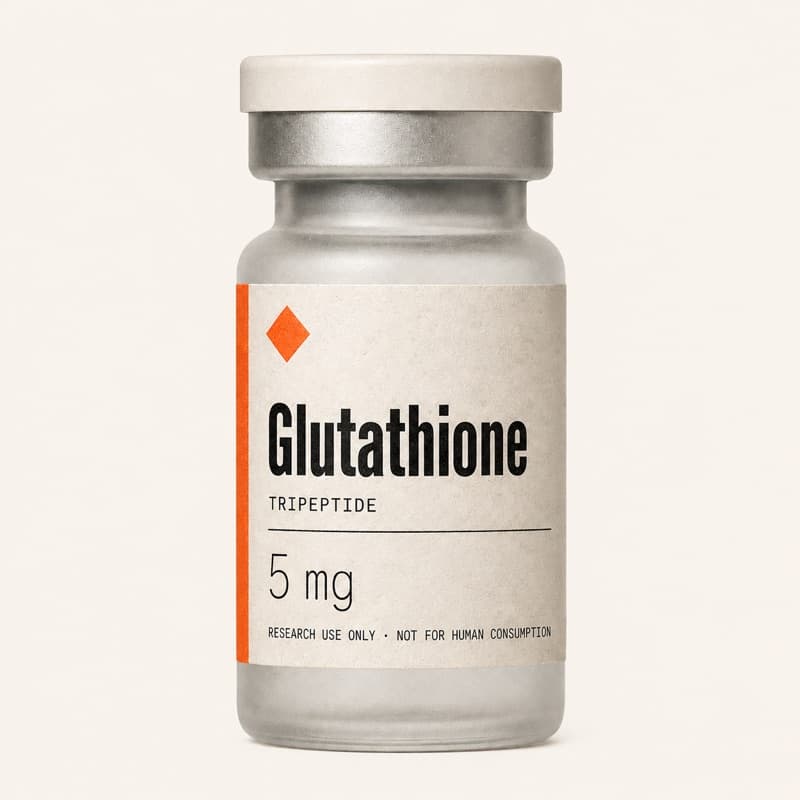
Glutathione
L-Glutathione · Master Antioxidant Tripeptide
The master antioxidant of the body, a tripeptide the liver produces on its own. Cells are protected against heavy metals, peroxides, and free radicals, and toxins are eliminated, drugs and pollutants among them. Gastrointestinal breakdown is bypassed by the injectable form, giving bioavailability superior to that of oral supplements. Benefits for immune function, neurological health, skin health, and anti-aging are supported by research.
Overview
The master antioxidant of the body, a tripeptide the liver produces on its own. Cells are protected against heavy metals, peroxides, and free radicals, and toxins are eliminated, drugs and pollutants among them. Gastrointestinal breakdown is bypassed by the injectable form, giving bioavailability superior to that of oral supplements. Benefits for immune function, neurological health, skin health, and anti-aging are supported by research.
The primary intracellular antioxidant, glutathione neutralizes reactive oxygen species directly and regenerates other antioxidants, vitamins C and E among them. Detoxification turns on it heavily, toxins being conjugated for elimination; immune function is supported through the regulation of T cells; mitochondria are protected; cellular redox balance is held steady. Antioxidant activity comes from the thiol group of cysteine.
Research indications
What the compound has been studied for, grouped by body system. Effect size is the reported magnitude where it was measured — not a recommendation.
Case studies of IV glutathione reported better mental function and speech quality.
Neurons are protected from oxidative damage, and brain health supported.
Skin health is supported, with possible brightening by way of melanin modulation.
In HIV patients on supplementation, Th1 cytokines and immune markers improved.
Age-related oxidative stress is countered and cellular longevity supported.
The cell's primary antioxidant: free radicals are neutralized and oxidative damage guarded against.
Heavy metals and environmental toxins are bound, and their elimination facilitated.
Liver protection and the hepatic detoxification pathways both depend on it.
- Class
- Tripeptide
- Research status
- Extensively studied
- Chain length
- 3 residues
- Molecular weight
- 307.32 Da
- Half-life
- ~12 min
- Typical dose
- 100–600 mg injectable (100–200 mg wellness, 200–600 mg intensive); IV dosing higher (600–1400 mg clinical)
- Frequency
- 2–3 times weekly for subcutaneous; weekly for IV infusions
- Cycle length
- 8–12 weeks
- Storage
- Lyophilized: 2-8°C refrigerated, protect from light; Reconstituted: 2-8°C refrigerated, protect from light
Molecular data
- Type
- Tripeptide
- Molecular weight
- 307.32 Da
- Chain length
- 3 residues
- Half-life
- 12 min
Levels in single-dose multiples. A shape, not a pharmacokinetic prediction.
Dosing reference
Doses reported in the literature and by suppliers. These are a record of what has been used in research — reference, never instruction.
| Context | Route | Amount | Frequency |
|---|---|---|---|
| General wellness | SubQ | 100-200 mg | 2-3x weekly |
| Intensive therapy | SubQ or IV | 200-600 mg | 2-3x weekly |
| Detoxification | IV (clinical) | 600-1000 mg | Weekly IV |
| Parkinson's support | IV (clinical) | 1400 mg | 2-3x weekly |
| Daily supplementation | Oral | 250-1000 mg | Daily |
Interactions
Cellular energy and antioxidant systems are supported by each; longevity protocols commonly combine them.
Oxidized vitamin C is regenerated by glutathione, and the antioxidant effect is synergistic.
Mitochondria are protected by both, on different mechanisms that complement.
No negative interactions are known.
What to expect
Safety
Mechanistic flags — properties of the pathway, not observed adverse events.
- Injection site reactions
- Mild nausea (usually with higher doses)
- Abdominal cramping
- Signs of allergic reaction (rash, difficulty breathing)
- Severe abdominal pain
- Signs of zinc deficiency
- Known allergy to glutathione
- Pregnancy or breastfeeding (insufficient safety data)
- Asthma (may trigger bronchospasm in some)
Quality checklist
What to confirm before trusting a batch of research material. A verification aid — not an endorsement of any supplier.
- Third-party Certificate of AnalysisIndependent lab · dated · lot-matched.
- HPLC purity ≥ 98%Reverse-phase trace included.
- Mass-spec confirms 307.32 g/molMALDI-TOF or ESI-MS.
- Counterion stated (acetate ≫ TFA)TFA salts can confound bioassays.
- Endotoxin / sterility statementRelevant once reconstituted.
- Lyophilised · cold-chain shippedStored −20 °C, shipped on ice.
- Labelled “research use only”No therapeutic or dosing claims.
Recorded signals for this compound · 8
- ✓Reduced (not oxidized) form
- ✓Lyophilized powder, white to off-white
- ✓Solution clear once reconstituted
- ✓Vacuum seal intact
- !A slight yellow cast may point to oxidation
- ×Cloudy solution
- ×Coloration in dark yellow or brown
- ×A strong sulfur odor, past mild
FAQ
What makes injectable glutathione outperform oral supplements?
Bioavailability is poor by mouth: enzymes and stomach acid break the molecule down in the GI tract, and most of it is destroyed before absorption. The injectable form bypasses that GI degradation and goes to direct cellular uptake. Bioavailable concentrations from IV or SubQ delivery run 10–100× higher than even liposomal oral forms.
Does glutathione actually change skin tone, or is that a myth?
Skin-lightening effects are legitimate and run through melanin modulation: systematic reviews found the melanin index significantly reduced against placebo at oral doses of 250–500 mg. The IV form shows effects too, though the results there are variable and controversial. Not a myth, then, but results vary greatly from person to person.
What is known about glutathione in Parkinson's disease?
One double-blind pilot study gave IV glutathione at 1,400 mg, 3× weekly for 4 weeks, to 21 Parkinson's patients: it was well-tolerated, and there were preliminary suggestions of symptomatic benefit. Effects were modest all the same. That puts it as a research-supported adjunct therapy rather than a primary treatment, and under medical supervision.
How do reduced and oxidized glutathione differ?
GSH, the reduced form, is the active antioxidant and the one that neutralizes free radicals. GSSG, the oxidized form, is what remains once a free radical has been neutralized, and it is inactive. Supplements worth having are the reduced kind; oxidized forms carry no antioxidant benefit. Quality products state 'reduced' on the label.
References
- 1Glutathione metabolism and its implications for healthWu G, Fang YZ, Yang S, Lupton JR, Turner ND · Journal of Nutrition · 2004
Comprehensive review establishing glutathione's roles in antioxidant defense, nutrient metabolism, regulation of gene expression, DNA/protein synthesis, cell proliferation and apoptosis, immune response, and protein glutathionylation.
ReviewPubMed 14988435 ↗ - 2Randomized, double-blind, pilot evaluation of intravenous glutathione in Parkinson's diseaseHauser RA, Lyons KE, McClain T, Carter S, Perlmutter D · Movement Disorders · 2009
21 PD subjects randomized to IV glutathione 1,400 mg or placebo 3x weekly for 4 weeks. Well tolerated with no safety concerns. Preliminary data suggested possibility of mild symptomatic effect.
Human RCTPubMed 19230029 ↗ - 3Liposomal Glutathione Supplementation Restores TH1 Cytokine Response to Mycobacterium tuberculosis Infection in HIV-Infected IndividualsLy J, Lagman M, Saing T, Singh MK, Tudella EV, Morris D, Anderson J, Daliva J, Ochoa C, Patel N, Venketaraman V · Journal of Interferon & Cytokine Research · 2015
13-week liposomal glutathione supplementation in HIV-infected individuals resulted in significant increases in plasma Th1 cytokines IL-12 and IFN-γ, restoring immune response.
Review · inferredPubMed 26133750 ↗ - 4Exploring the Safety and Efficacy of Glutathione Supplementation for Skin Lightening: A Narrative ReviewVarious · Cureus · 2025
Narrative review concluding glutathione has potential as a depigmenting agent. Oral supplementation shows significant but variable melanin reduction. IV use associated with safety concerns including anaphylaxis.
ReviewPubMed 40013212 ↗
Across five randomised trials, oral glutathione dosed at 250-500 mg reduced the melanin index significantly relative to placebo and topical preparations were also effective, while intravenous use has no standardised protocol.
Over three months, sustained oral glutathione dosing in elderly patients with type 2 diabetes raised blood GSH, cut the oxidative damage marker 8-OHdG, and produced a significant improvement in HbA1c.