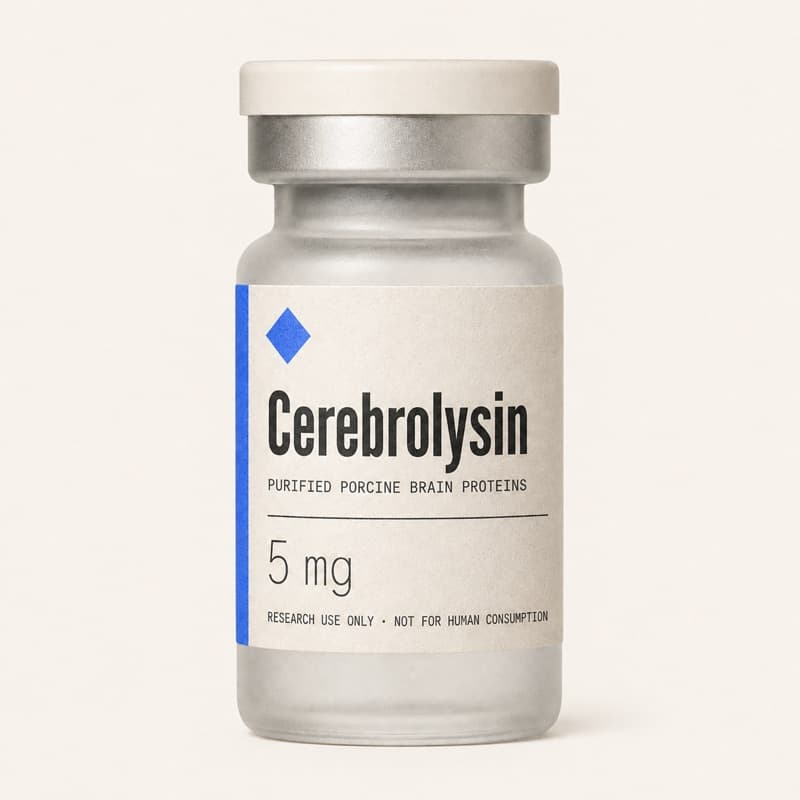
Cerebrolysin
Neuropeptide Preparation · Neurological Recovery
Standardized preparation of neuropeptides, made up of bioactive peptides and amino acids with neurotrophic and neuroprotective properties. Applications are stroke recovery, traumatic brain injury, and cognitive enhancement; clinical use spans more than 50 countries.
Overview
Standardized preparation of neuropeptides, made up of bioactive peptides and amino acids with neurotrophic and neuroprotective properties. Applications are stroke recovery, traumatic brain injury, and cognitive enhancement; clinical use spans more than 50 countries.
Bioavailability and brain penetration of the neuropeptides and neurotrophic factors are optimal by IV/IM administration.
Research indications
What the compound has been studied for, grouped by body system. Effect size is the reported magnitude where it was measured — not a recommendation.
A large meta-analysis reports significant NIHSS improvements; functional benefit was absent in other studies.
Modest cognitive improvement appears in meta-analyses, with clinical significance still debated.
Significant improvement on ADAS-cog and CIBIC+ across multiple RCTs.
The largest meta-analysis, 1,879 patients, shows benefit on NIHSS; independent analysis found no improvement in mRS.
GCS/GOS improvements are confirmed across several trials, the CAPTAIN series among them.
A pilot trial reports promising outcomes at 6 months; larger confirmatory studies are required.
Enhanced recovery appears in some studies; results differ significantly from trial to trial.
Administration inside 72 hours produces better outcomes than treatment that is delayed.
- Class
- Purified porcine brain proteins
- Research status
- Well studied
- Half-life
- ~10 min
- Typical dose
- 10–50 mL (fixed-concentration commercial solution; range is indication-dependent in clinical literature)
- Frequency
- Once daily for acute conditions; 5 days weekly for chronic conditions
- Cycle length
- 7–30 days depending on condition (stroke/TBI 10–30 days, dementia 4 weeks)
- Storage
- Room temperature ≤25°C, protected from light in original carton - never freeze
Molecular data
- Type
- Purified porcine brain proteins
- Half-life
- 10 min
Levels in single-dose multiples. A shape, not a pharmacokinetic prediction.
Dosing reference
Doses reported in the literature and by suppliers. These are a record of what has been used in research — reference, never instruction.
| Context | Route | Amount | Frequency |
|---|---|---|---|
| Small Volume IV | Undiluted IV slow push over 3 minutes | Up to 10mL | Once daily |
| Intramuscular | Undiluted IM injection over 3 minutes | Up to 5mL | Once daily |
| Acute Stroke | IV infusion (diluted to 100mL minimum) | 20-50mL | Once daily for 10-21 days |
| Traumatic Brain Injury | IV infusion (diluted to 100mL minimum) | 20-50mL | Once daily for 7-30 days |
| Alzheimer's Disease | IV injection/infusion (2-4 cycles yearly) | 10-30mL | 5 days weekly for 4 weeks |
| Vascular Dementia | IV injection/infusion (2-4 cycles yearly) | 10-30mL | 5 days weekly for 4 weeks |
Interactions
The prescribing information contraindicates this; no mixing within one infusion.
A safe combination, with no significant interactions; cognitive function is supported by both.
No interactions are reported; cognitive effects in Alzheimer's treatment may be synergistic.
Neurotropic effects may be additive; watch for antidepressant effects that are enhanced.
Neurological effects may add together; careful monitoring is required.
Official guidelines rule out mixing the two in one IV infusion.
Compatibility issues arise; the two should not share an IV infusion.
Neurotrophic factors are enhanced by both; effects may be additive, so lower starting doses apply.
What to expect
Safety
- Tolerated well overall
- Mild dizziness or agitation possible early in treatment
- Significant cardiovascular events in the course of administration
- Severe allergic reaction, such as anaphylaxis or severe rash
- Onset of new seizure activity
- Severe renal dysfunction, or kidney function that is worsening
- Epilepsy
- Severe renal insufficiency
- Prior severe allergic reaction to porcine products
Quality checklist
What to confirm before trusting a batch of research material. A verification aid — not an endorsement of any supplier.
- Third-party Certificate of AnalysisIndependent lab · dated · lot-matched.
- HPLC purity ≥ 98%Reverse-phase trace included.
- Mass-spec identity confirmedMALDI-TOF or ESI-MS.
- Counterion stated (acetate ≫ TFA)TFA salts can confound bioassays.
- Endotoxin / sterility statementRelevant once reconstituted.
- Lyophilised · cold-chain shippedStored −20 °C, shipped on ice.
- Labelled “research use only”No therapeutic or dosing claims.
Recorded signals for this compound · 7
- ✓Solution clear and amber, from a reputable source
- ✓Stored at room temperature, ≤25°C
- ✓Kept in the original carton, away from light
- ✓Distributor authorized by EVER Pharma
- !Retractions for research misconduct have hit some published studies; independent meta-analyses are what to rely on
- ×Product frozen, or storage otherwise improper — freezing is never appropriate
- ×Mixed into incompatible solutions — cardiovascular medications, vitamins, amino acids
FAQ
How strong is the evidence for Cerebrolysin in stroke recovery?
The evidence is mixed. A large meta-analysis covering 1,879 stroke patients found superiority on NIHSS, the neurological function scale, while an independent analysis saw no significant improvement on the modified Rankin Scale, which measures functional outcomes. What emerges is early neurological benefit without a clear advantage in long-term functional recovery.
Given that some published studies were retracted, is Cerebrolysin safe?
Yes. Several Cerebrolysin studies were retracted for research misconduct, but safety and modest efficacy signals are confirmed by well-conducted meta-analyses from independent researchers. The sounder basis is meta-analyses and well-designed RCTs rather than individual studies, some of which carry credibility issues.
How soon after stroke or TBI does Cerebrolysin need to start for best results?
Outcomes are better when administration falls inside 72 hours rather than later. Acute stroke protocols run 20–50mL daily by IV infusion across 10–21 days; TBI protocols use similar dosing for 7–30 days, scaled to severity. For neuroprotective benefit, earlier initiation appears critical.
Can Cerebrolysin share an infusion with vitamins, medications, or other IV solutions?
No. Mixing with amino acid solutions, cardiovascular medications or vitamin solutions in one IV infusion is contraindicated by official guidelines. Compatibility issues exist, which makes dedicated IV lines necessary. Protocol calls for a sodium chloride flush before and after administration.
References
- 1Cerebrolysin in Mild-to-Moderate Alzheimer's Disease: A Meta-Analysis of Randomized Controlled Clinical TrialsGauthier S, Proano JV, Jia J, et al. · Dementia and Geriatric Cognitive Disorders · 2015
6 RCTs in mild-to-moderate AD; Cerebrolysin significantly superior to placebo on ADAS-cog at 4 weeks (SMD -0.40, P=0.003) and CIBIC global clinical change at 4 weeks and 6 months.
Meta-analysisPubMed 25832905 ↗ - 2Cerebrolysin for Functional Recovery in Patients with Acute Ischemic Stroke: A Meta-Analysis of Randomized Controlled TrialsXue LX, Zhang T, Zhao YW, et al. · International Journal of Neuroscience · 2017
Meta-analysis of 1,779 patients found no significant benefit on mRS response (RR 1.33, P=0.28) or Barthel Index; concluded routine use for long-term stroke rehabilitation not supported.
Meta-analysisPubMed 28458521 ↗ - 3Safety and Efficacy of Cerebrolysin in Early Post-Stroke Recovery: A Meta-Analysis of Nine Randomized Clinical TrialsBornstein NM, Guekht A, Vester J, et al. · Neurological Sciences · 2018
Meta-analysis of 1,879 stroke patients showed NIHSS superiority of Cerebrolysin (MW 0.60, P < 0.0001); NNT = 7.7 for clinically relevant early neurological improvement.
Meta-analysisPubMed 29248999 ↗ - 4Efficacy and Safety of Cerebrolysin in Neurorecovery After Moderate-Severe Traumatic Brain Injury: Results from the CAPTAIN II TrialMuresanu DF, Florian S, et al. · Neurological Sciences · 2020
Phase IIIb/IV RCT: patients with GCS 7-12 received 50 mL Cerebrolysin daily for 10 days + two additional 10 mL cycles; confirmed beneficial effects on overall outcome after moderate-severe TBI.
Human RCTPubMed 31897941 ↗ - 5Cerebrolysin in Patients with TBI: Systematic Review and Meta-AnalysisJarosz K, Kojder K, Andrzejewska A, Solek-Pastuszka J, Jurczak A · Brain Sciences · 2023
10 studies of 8,749 TBI patients; GOS improvement was statistically significant (mean difference 0.422, P = 0.000); mortality and length of stay were not significantly affected.
ReviewPubMed 36979317 ↗
Pooling 185 patients across the CAPTAIN I and II trials, this prospective meta-analysis found Cerebrolysin safe and effective in moderate to severe traumatic brain injury; admission GCS averaged 10.3.
In an observational cohort of 47 patients with subarachnoid haemorrhage, Cerebrolysin paired with neuromonitoring was associated with lower mortality in severe cases, while raw Glasgow Outcome Scale scores and length of stay showed no significant difference.
A review of how Cerebrolysin may act in vascular dementia, tracing its neuroprotective effects to peptides that cross the blood-brain barrier and support neuroplasticity, neurogenesis, and neurotrophicity.