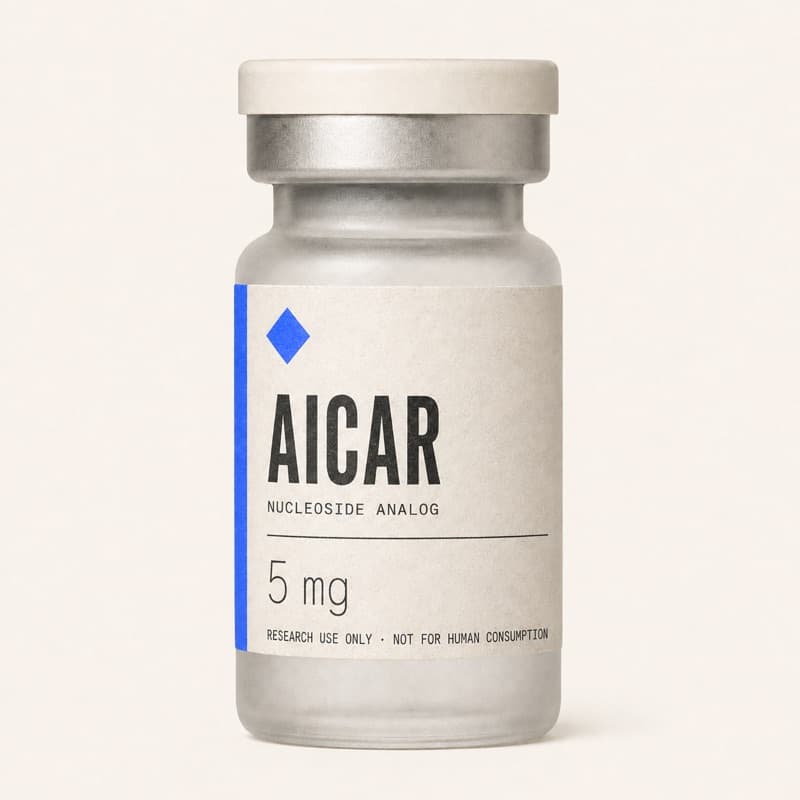
AICAR
5-Aminoimidazole-4-carboxamide Ribonucleotide · AMPK Activator
Cell-permeable nucleoside analog whose target is AMP-activated protein kinase (AMPK), a key regulator of cellular energy homeostasis. Cardiac ischemia protection was the first research application; the metabolic effects later earned it the label 'exercise mimetic'.
Overview
Cell-permeable nucleoside analog whose target is AMP-activated protein kinase (AMPK), a key regulator of cellular energy homeostasis. Cardiac ischemia protection was the first research application; the metabolic effects later earned it the label 'exercise mimetic'.
Inside the cell, AICAR undergoes phosphorylation to ZMP; ZMP imitates AMP and switches AMPK on. The metabolic pathways that follow are the ones exercise typically activates — glucose uptake raised, fatty acid oxidation, mitochondrial biogenesis.
Research indications
What the compound has been studied for, grouped by body system. Effect size is the reported magnitude where it was measured — not a recommendation.
Accumulated ZMP activates the master metabolic regulator directly.
Fat burning rises by way of AMPK-mediated pathways.
In some tissues, glucose uptake is enhanced independently of insulin.
Running endurance increased in animal studies; the human data is limited.
Over time, activation of AMPK promotes formation of new mitochondria.
The original clinical interest: heart tissue may be protected while blood flow is reduced.
- Class
- Nucleoside analog
- Research status
- Limited research
- Molecular weight
- 338.21 Da
- Half-life
- ~2.5 h
- Typical dose
- 1–5 mg daily
- Frequency
- Once daily
- Cycle length
- 8–12 weeks
- Storage
- Lyophilized: -20°C; Reconstituted: 2-8°C for 4 weeks
Molecular data
- Type
- Nucleoside analog
- Molecular weight
- 338.21 Da
- Half-life
- 150 min
Levels in single-dose multiples. A shape, not a pharmacokinetic prediction.
Dosing reference
Doses reported in the literature and by suppliers. These are a record of what has been used in research — reference, never instruction.
| Context | Route | Amount | Frequency |
|---|---|---|---|
| Standard Protocol | SubQ | 1-3mg | Daily |
| Gradual Introduction | SubQ | 1mg → 2mg → 3mg | Daily, titrating over 4 weeks |
| Advanced Protocol | SubQ | 3-5mg | Daily for 8-12 weeks |
Interactions
AMPK is activated by both, through different mechanisms. In combination, effects on glucose metabolism may be additive.
Separate pathways — AMPK against PPARδ — whose metabolic effects may complement. A popular research combination.
A Rev-ErbA agonist whose metabolic effects complement.
What to expect
Safety
Mechanistic flags — properties of the pathway, not observed adverse events.
- Injection site reactions
- Potential hypoglycemia
- Mild fatigue over the adaptation period
- Severe hypoglycemia symptoms
- Unusual cardiac symptoms
- Severe fatigue or weakness
- Lactic acidosis symptoms — difficulty breathing, weakness, muscle pain
- Cardiac conditions
- Pregnancy or breastfeeding
- Diabetes, with hypoglycemia risk
- Athletes in competition — prohibited by WADA
Quality checklist
What to confirm before trusting a batch of research material. A verification aid — not an endorsement of any supplier.
- Third-party Certificate of AnalysisIndependent lab · dated · lot-matched.
- HPLC purity ≥ 98%Reverse-phase trace included.
- Mass-spec confirms 338.21 g/molMALDI-TOF or ESI-MS.
- Counterion stated (acetate ≫ TFA)TFA salts can confound bioassays.
- Endotoxin / sterility statementRelevant once reconstituted.
- Lyophilised · cold-chain shippedStored −20 °C, shipped on ice.
- Labelled “research use only”No therapeutic or dosing claims.
Recorded signals for this compound · 7
- ✓Purity testing included in the certificate of analysis
- ✓Lyophilized powder, white to off-white
- ✓Solution clear once reconstituted
- !Yellowing may appear slightly; dissolution should still be clear
- ×Particulate matter visible
- ×Powder clumped or discolored
- ×Solution cloudy once reconstituted
FAQ
Is AICAR an 'exercise mimetic' in humans?
Animal studies record a 44% increase in running endurance with no training. Those were mice, not humans. Endurance effects have never been adequately tested in humans, which leaves the exercise-mimetic label speculative. AMPK activation and increased fat oxidation do happen, but real-world performance gains in people remain unproven.
Is AICAR banned in competitive sport, and on what grounds?
Yes — it sits on the WADA prohibited list. Anabolic it is not, but competitive advantage follows from enhanced metabolic efficiency and endurance. Athletes competing under WADA rules have to avoid it entirely, given the likelihood of testing and strict liability regulations.
What hypoglycemia risk does AICAR carry outside of diabetes?
Glucose uptake rises independently of insulin in some tissues, which creates a theoretical hypoglycemia risk — especially in non-diabetics whose insulin sensitivity is normal. The risk is more serious in diabetics, and that is why diabetes is a contraindication. Blood glucose warrants close monitoring, particularly across the initial doses.
For metabolic enhancement, what separates AICAR from GW501516?
AICAR switches on AMPK — the master metabolic regulator — and fatty acid oxidation and glucose uptake rise with it. GW501516 is a PPARδ agonist, its downstream effects differing. Stacking is common because the pathways complement: AMPK plus PPARδ activation yields synergistic metabolic effects.