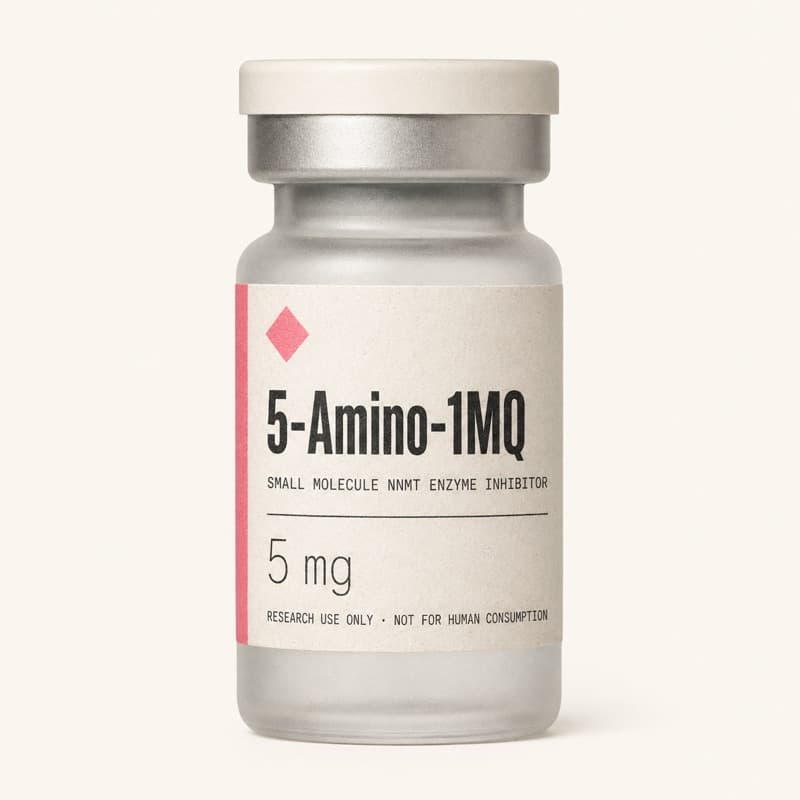
5-Amino-1MQ
NNMT Inhibitor · Longevity & Metabolic Enhancement
Small molecule inhibitor of NNMT (nicotinamide N-methyltransferase) that raises cellular NAD+ levels and mitochondrial function. It is not a true peptide but a small molecule compound, in use within longevity and metabolic optimization protocols.
Overview
Small molecule inhibitor of NNMT (nicotinamide N-methyltransferase) that raises cellular NAD+ levels and mitochondrial function. It is not a true peptide but a small molecule compound, in use within longevity and metabolic optimization protocols.
Systemic inhibition of the NNMT enzyme blocks the degradation of NAD+, holding cellular NAD+ at an elevated level; mitochondrial function and metabolic processes are supported downstream of that.
Research indications
What the compound has been studied for, grouped by body system. Effect size is the reported magnitude where it was measured — not a recommendation.
Inhibition of the NNMT enzyme raises cellular NAD+ significantly; the DNA repair mechanisms and cellular energy production that healthy aging rests on are supported as a result.
Mitochondrial biogenesis and efficiency both improve; cellular energy production rises and the oxidative stress markers tied to aging fall.
Wider NAD+ availability feeds sirtuins along with other longevity pathways — those implicated in stress resistance, cellular maintenance, and DNA repair.
Gains attributed to greater mitochondrial efficiency.
Enhancement follows from optimized cellular energy.
Substrate switching between glucose and fat improves.
An increase in basal metabolic rate is supported.
Capacity for burning fat improves.
- Class
- Small molecule NNMT enzyme inhibitor
- Research status
- Preclinical
- Half-life
- ~5.5 h
- Typical dose
- 50–100 mg oral or 150–500 µg subcutaneous
- Frequency
- Once daily, typically morning
- Cycle length
- 8–12 weeks continuous
- Storage
- Oral: room temp. Injectable: lyophilized room temp or freezer, reconstituted 2-8°C for 28 days
Molecular data
- Type
- Small molecule NNMT enzyme inhibitor
- Half-life
- 330 min
Levels in single-dose multiples. A shape, not a pharmacokinetic prediction.
Dosing reference
Doses reported in the literature and by suppliers. These are a record of what has been used in research — reference, never instruction.
| Context | Route | Amount | Frequency |
|---|---|---|---|
| Conservative initiation | Oral with food | 25mg | 1x daily |
| Standard starting dose | Oral with food | 50mg | 1x daily |
| Typical maintenance | Oral with food | 75mg | 1x daily |
| Maximum dose | Oral with food | 100mg | 1x daily |
| Split dosing protocol | Oral with meals | 50mg | 2x daily |
| Conservative starting (mcg protocol) | SubQ | 150-250mcg | 1x daily |
| Conservative standard (mcg protocol) | SubQ | 250-500mcg | 1x daily |
| Study-based (mg protocol) | SubQ | ~350mg (5mg/kg) | 1x daily |
Interactions
Possible synergy: breakdown prevented on one side, production supported on the other.
Longevity is supported by both — sirtuin activation from resveratrol, NAD+ substrate from 5-Amino-1MQ.
Metabolic pathways are affected by both; effects may be enhanced in combination, though careful monitoring is required.
No interactions known; separate mechanisms whose benefits may complement.
Interaction data is limited; a healthcare provider should be consulted before the two are combined.
Both act on metabolic pathways, with additive effects on glucose metabolism possible.
What to expect
Safety
Mechanistic flags — properties of the pathway, not observed adverse events.
- Mild gastrointestinal adjustment, occasionally
- Late-in-the-day dosing carries potential sleep interference
- Side effects minimal overall
- Persistent nausea, or severe gastrointestinal upset
- Unusual fatigue or weakness — the opposite of the effect expected
- Headaches that persist, or dizziness
- Marked mood changes, or anxiety
- Disturbed sleep or insomnia
- Allergic reactions such as rash, swelling, or difficulty breathing
- Metabolic conditions already present; a healthcare provider should be consulted
- Pregnancy or breastfeeding
Quality checklist
What to confirm before trusting a batch of research material. A verification aid — not an endorsement of any supplier.
- Third-party Certificate of AnalysisIndependent lab · dated · lot-matched.
- HPLC purity ≥ 98%Reverse-phase trace included.
- Mass-spec identity confirmedMALDI-TOF or ESI-MS.
- Counterion stated (acetate ≫ TFA)TFA salts can confound bioassays.
- Endotoxin / sterility statementRelevant once reconstituted.
- Lyophilised · cold-chain shippedStored −20 °C, shipped on ice.
- Labelled “research use only”No therapeutic or dosing claims.
Recorded signals for this compound · 10
- ✓Appearance running white to off-white — orange/amber for powder
- ✓Uniform in color and size, with labeling and batch information clear
- ✓COA from third-party testing showing purity >98%
- ✓Packaging proper to pharmaceutical use, protecting against moisture
- ✓Expiration dates clear, labeling professional
- !Clumping or moisture damage can point to degradation
- ×Appearance that is heat-damaged, discolored, or sticky
- ×Odor out of the ordinary; the material should be relatively odorless
- ×Contamination indicated by strong chemical odors
- ×Reconstituted solution cloudy, for injectables
FAQ
Injection of 5-Amino-1MQ: what separates the µg protocol from the mg protocol?
Two dosing protocols circulate and they differ by 100–200×: the µg protocol runs 150–500 µg daily, the mg protocol roughly 350 mg (5 mg/kg) daily. Serious overdose risk follows from that discrepancy. Verification of units — µg against mg — belongs before reconstitution, because the available dosing error is 100-fold or greater.
Does 5-Amino-1MQ raise NAD+ levels in humans?
Significant NAD+ elevation via NNMT inhibition is demonstrated in animal studies. Aged mice given 5A1MQ in a 2024 study gained roughly 40% more grip strength than controls, alongside improved intramuscular lipid content and muscle fiber cross-sectional area — evidence that raised NAD+ carries through to functional improvement.
Is 5-Amino-1MQ taken with food, or on an empty stomach?
Dosing with food improves absorption and reduces potential GI effects. Steady NAD+ levels are helped by consistent daily timing, and morning or early afternoon is the preferred window, which avoids potential sleep interference.
References
- 1Selective and membrane-permeable small molecule inhibitors of nicotinamide N-methyltransferase reverse high fat diet-induced obesity in miceNeelakantan H, Vance V, Wetzel MD, Wang HL, McHardy SF, Finnerty CC, Hommel JD, Watowich SJ · Biochemical Pharmacology · 2018
Diet-induced obese mice showed significant weight loss and adipocyte size reduction with 5-amino-1MQ treatment. Demonstrated that NNMT inhibition increases energy expenditure, reduces body weight and white adipose mass, improves insulin sensitivity, and normalizes glucose tolerance.
Animal in vivo · inferredPubMed 29155147 ↗ - 2Development & validation of LC-MS/MS assay for 5-amino-1-methyl quinolinium in rat plasma: Application to pharmacokinetic and oral bioavailability studiesKannt A et al. · Journal of Pharmaceutical and Biomedical Analysis · 2021
Demonstrated 38.4% oral bioavailability, half-life 6.9hr (oral) and 3.8hr (IV). Validated sensitive LC-MS/MS method for pharmacokinetic assessment supporting oral administration viability.
Animal in vivoPubMed 34304009 ↗ - 3Nicotinamide N-methyltransferase inhibition mimics and boosts exercise-mediated improvements in muscle function in aged miceNeelakantan H et al. · Scientific Reports · 2024
NNMTi-treated aged sedentary mice showed ~40% greater grip strength than controls. Combined with exercise, 60% grip strength increase. Also improved intramuscular lipid content and gastrocnemius fiber cross-sectional area.
Animal in vivoPubMed 38969654 ↗
In mice made obese by diet, 5-amino-1MQ blocked nicotinamide N-methyltransferase, curbing gains in weight and fat mass in a dose-related manner while leaving feeding unchanged, with liver pathology also improved.
Machine-learning analysis flagged nicotinamide N-methyltransferase (NNMT) as a gene central to metabolic dysregulation in sarcopenia; inhibiting NNMT in aged mice raised grip strength, blunted the age-related loss of muscle mass, and lifted NAD+ content alongside PGC1α expression.